How we stay LEAN at Tactile
The Art of Adaptation
Given our inability to predict market conditions for the upcoming year, our ability to adapt swiftly becomes critical for survival.
Tactile has, for a long time, been defined as a developer of great story-driven, puzzle games. Whilst this held true for us for over a decade, and in particular since the launch of Lily’s Garden in 2019, we have in more recent years been observing big shifts in the casual mobile gaming market… which is becoming more and more hybrid-casual.
For us, this meant rethinking our strategy in terms of product. We wanted to challenge ourselves: first, to get better at launching games faster, and second, to shift our focus from story back to gameplay and to challenge ourselves with developing new core game mechanics.
This meant big changes for the business – both in terms of product focus and in terms of our workflows and processes. We have gotten really good at managing big productions, such as Lily’s Garden, which runs as a well oiled machine with weekly releases. Now we had to adjust to running smaller game productions with completely undefined processes.
As our culture is rooted in 3 core pillars – lean processes, agile workflows, and flat hierarchy – staying loyal to these has become more important than ever. Here’s why 👇
Our Culture Pillars
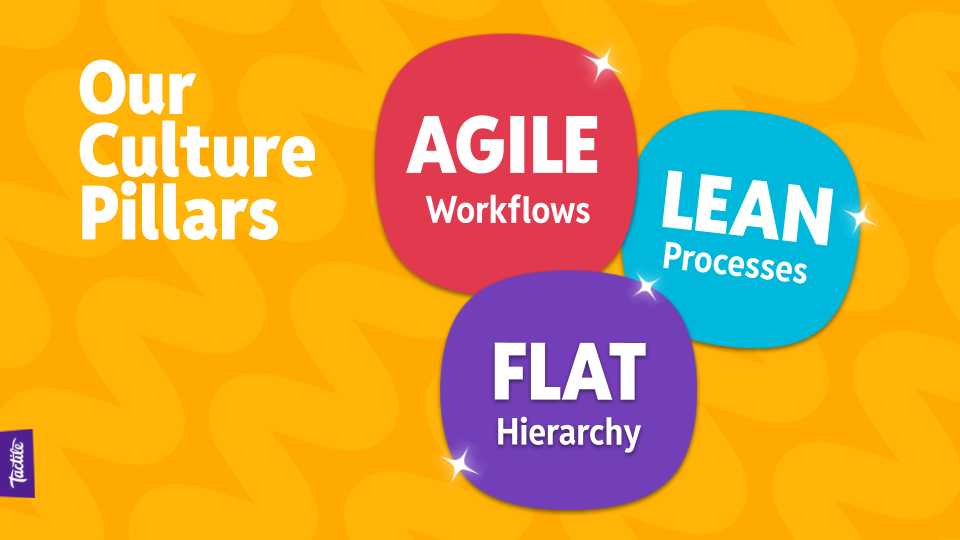
🔥Flat hierarchy – Our commitment as a lean company is to the work and the person, and not to the restrictions of a job title. It is hard for us to predict what we might need in a year’s time, so we instead commit to the people we work with and to growing their areas of expertise. We do so by enabling short decision paths and direct access to leadership, with high ownership at team level.
🔥Increasing outputs (agile workflows) – We want to get everyone as close as we can to giving max value. The only way to do that is for everyone to be aware of identifying processes that don’t make sense (the so-called ‘wastes’). We do so by fostering an open environment, where everyone is encouraged to share – ideas, observations, and most importantly, feedback – and that’s right at the heart of our culture. Specialists get to influence direction, not just implementation.
🔥 Identifying and removing non-value adding activities (lean processes) – We don’t want to spend time and resources that don’t add value to our production processes (and create ‘waste’). We make games, so a process doesn’t end when new content is delivered – it ends when it gets successfully released and our players get to experience it.
Let’s dive further into the 7 wastes* that our lean thinking aims to remove from our work processes.
The 7 Wastes of Lean
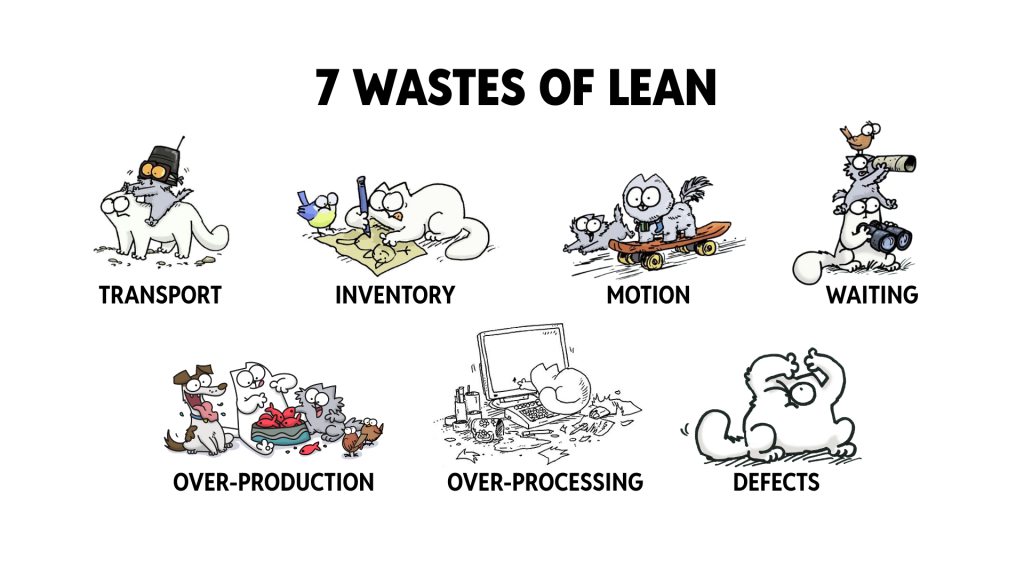
#1 TRANSPORT
💡One way to imagine transport waste is when tasks get reassigned and restarted from scratch, or when individual priorities get rearranged.
In the context of Tactile, this means finding ways to ensure everyone can successfully complete the tasks they are working on.
We want to make sure that tasks don’t get reshuffled or restarted too often and that, if someone starts something, they have the tools and support needed to finish it. Then we look into how we can better set each individual or task up for success in the future.
#2 INVENTORY
💡Inventory relates to the lean organization’s ability to avoid having many tasks in the backlog and setting too many priorities.
In our context, this means that if we start working on a feature, we need to be able to release it to the players. We want to avoid logistics and administration along the way, which ultimately does not add value for the player.
The point is that we don’t want great ideas and important tasks to sit in a backlog – we want them to see the light of day, because in a short time, they might no longer be relevant.
#3 MOTION
💡 Motion relates to finding ways to have everything that is needed to complete a task in one place.
As the lean organization was born in a factory (Toyota), motion waste originally referred to workers having to move around the factory a lot to be able to do the same thing over and over again (i.e., put tires on a car).
It turns out that in reality, multitasking doesn’t really work. At the same time, when tasks switch hands, it often takes focus away. At Tactile, we want to minimize motion waste by having people focus on one thing at a time and doing that really well (i.e., in QA we try to minimize testers switching between different games and features too often).
#4 WAITING
💡Waiting refers to having to get thumbs up to be able to continue with your work.
In our context, this means that we do not want to create feedback gates. Instead, we want to enable feedback loops. We do not have a middle management layer validating and controlling everyone’s work, which reduces many bottlenecks.
Leadership might set the direction, but the teams decide on how to get there. We expect Tactilers to pull feedback and not leadership to push it. We don’t always work with strict deadlines, so we have to make sure that an individual’s work is not blocked by anyone or anything else. If you experience delays and serious waiting times, we need to talk about it.
#5 OVER-PRODUCTION
💡We do not produce a large amount of in-game content in advance. For us, value is not achieved when content is created, but when our players actually get to experience it. So when a new feature or story day is done, it immediately gets released.
Having said that, throughout all of our production processes, we want to make data-driven decisions. This gives us a way to continuously check if what we’re doing still makes sense. Just because we can do something doesn’t mean we should.
Yes, producing a large amount of content ahead of time means that you can have a more relaxed production pipeline, but if the market suddenly changes, you have to make that content all over again. This then leads to over-production.
#6 OVER-PROCESSING
💡At Tactile, we try to reduce the number of processes and meetings that we have.
For some, sitting in meetings and solving problems has value, but that is not necessarily the case for everyone.
If we identify that we are doing something that doesn’t add value or doesn’t make sense (like sitting in meetings), then we shouldn’t be doing it. Or we should at least put it up for discussion, to see what can be done differently. We also don’t do internal communication via emails or reports. We want people to talk to each other in person as much as possible.
#7 DEFECTS
💡We do quality checks all the time and at every single step.
For example, our programmers focus on clean coding principles and practices. They also get paired up with QA testers from the very start of the development of a new feature. It is crucial for QA to be present already at the ideation phase, as it helps flag any potential issues early on and prevents us from repeating the same mistakes over and over again.
It’s not about fixing bugs, but about avoiding them. The quality of new releases should not only be tested at the very end of their development cycle.
Lean Management Practices
Besides reducing wasteful processes, we also follow these two lean management practices:
POKA YOKE (or mistake proofing)
💡Avoid unexpected surprises!
This concept comes from the idea that we should never blame the user for things that are not working properly. For us, this refers to fool-proofing our internal tools and tech.
Are the tools easy to use and to understand? Whoever is making them should also think about how users could get them wrong. This is why, within our teams, we encourage everyone to give constructive criticism and to speak up when they see that something can be improved.
GEMBA WALK (‘The Real Place’)
💡Go and see, check, and talk.
We solve problems and search for solutions by talking to each other. A lot.
This is not about micromanagement, but about having a discussion in the moment we identify something that doesn’t work. To stay lean and to keep moving fast, we need to be able to talk to each other in real time.
Reflection
One of the key reflections of one of the lean leaders at Toyota (the principles of Lean originate from the Toyota car factory in Japan) is that despite them realistically not being able to reduce all waste from their processes, this is not stopping them from setting ambitious goals (0 waste). As technology develops, so do processes and so does our understanding of how we can work better and more efficiently.
We’re not at the perfect place yet, and we might never get there, but we continue working hard on ensuring we’re staying true to the core pillars of our culture and how we wish to operate as a workplace. This is to give the best possible experience to both our Tactilers and to our community of players all over the world.